Overcoming ADHD Paralysis: How a “Dopamine Menu” Can Fix Your Executive Dysfunction

Do you ever find yourself staring at a long to-do list, feeling completely overwhelmed, and instead of doing anything productive, you spend two hours mindlessly scrolling on your phone?
If this sounds familiar, you aren't lazy. You are likely experiencing ADHD paralysis caused by severe executive dysfunction.
For individuals living with Attention Deficit Hyperactivity Disorder (ADHD), starting a task isn't just a matter of willpower. It is a matter of brain chemistry. Lately, a trending neurological life-hack has taken the mental health community by storm to combat this exact issue: The Dopamine Menu (sometimes called a Dopamenu).
In this article, we will break down the science behind ADHD and dopamine, why traditional time-management tips fail neurodivergent brains, and how to build a personalised dopamine menu to boost your focus, manage stress, and reclaim your day.
The Link Between ADHD, Executive Dysfunction, and Dopamine
To understand why a dopamine menu works, we first need to look at what happens inside an ADHD brain.
Dopamine is a neurotransmitter responsible for motivation, pleasure, reward, and focus. In neurotypical brains, dopamine is released in anticipation of completing a task, giving them the "spark" needed to start washing dishes, writing a report, or replying to emails.
However, research shows that ADHD brains have lower baseline levels of dopamine and fewer dopamine receptors. This creates a state of executive dysfunction, the cognitive deficit that makes planning, organising, initiating tasks, and sustaining attention incredibly difficult.
When your brain is starving for dopamine, it enters a state of neurodivergent burnout or task paralysis. Your brain frantically searches for the fastest, easiest chemical hit available. Usually, this means turning to "cheap dopamine" fixes, such as:
Mindless social media scrolling
Binge-watching videos
Impulse online shopping
Snacking on sugary foods
While these activities give you an instant rush, they leave you feeling drained, guilty, and stuck in a procrastination loop.

What is a Dopamine Menu?
A Dopamine Menu is a visual, structured tool designed to pre-determine healthy, deeply fulfilling ways to stimulate your brain before you hit a wall of mental fatigue.
Think of it like walking into a restaurant when you are absolutely starving. If there is no menu, you might struggle to decide what you want, or you might grab the first junk food you see. A dopamine menu acts as a curated list of "brain food," categorising activities by how much time and energy they require.
By mapping this out ahead of time, you remove the heavy cognitive load of decision-making when your executive functions are low.
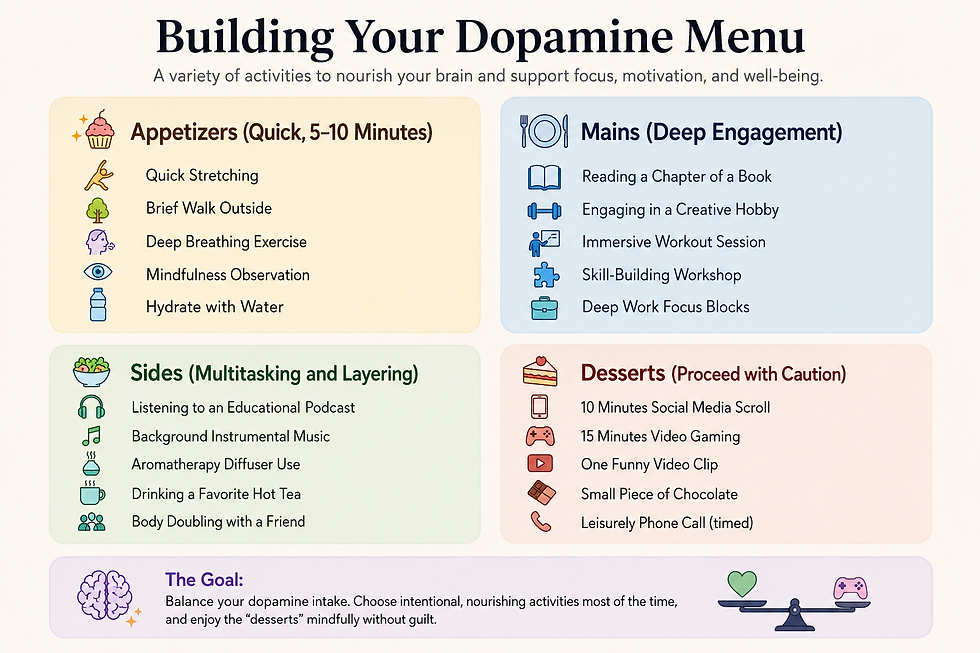
How to Build a Personalized Dopamine Menu
Ready to create your own? Grab a piece of paper, a digital template, or a journal and divide your menu into the following traditional restaurant courses:
1. Appetizers (Quick 5-10 Minute Hits)
These are rapid, accessible activities designed to give your brain a quick boost of energy when you feel task paralysis setting in. They help "wake up" your prefrontal cortex.
Examples: Stretching for 5 minutes, stepping outside for direct sunlight, putting on a favorite high-energy song, doing a quick breathing exercise, or playing with a pet.
2. Mains (Sustained, Deeply Fulfilling Activities)
These are longer activities (30 to 60 minutes) that require real engagement. They provide sustainable, high-quality dopamine that leaves you feeling genuinely refreshed, rather than depleted.
Examples: Going for a walk or run, engaging in a creative hobby (painting, playing an instrument, crafting), reading a chapter of a book, or cooking a nourishing meal from scratch.
3. Sides (Activities You Can Layer)
Sides are things you can pair with boring, low-dopamine tasks to make them more stimulating. This is a classic ADHD coping strategy known as "temptation bundling."
Examples: Listening to an engaging podcast while doing laundry, playing lo-fi music while answering emails, or using a fidget tool during a long virtual meeting.
4. Desserts (Proceed with Caution)
Desserts are the high-dopamine activities that feel amazing but are easy to overindulge in. You don't have to banish them from your life completely, but they require a "timer" or a boundary so you don't get stuck.
Examples: Playing video games, watching a favorite TV show, or browsing social media feeds.
Why a Dopamine Menu is a Game-Changer for ADHD Burnout
Traditional productivity advice tells you to "just push through it" or "break tasks into smaller steps." But when you are experiencing severe neurodivergent burnout, your brain physically lacks the fuel to do so.
A dopamine menu works because it respects your unique neurobiology. Instead of shaming yourself for lacking focus, you are actively learning how to work with your brain's natural reward system. It transitions you from a state of passive procrastination into active, intentional recovery.
Take the Next Step Toward Managing Adult ADHD
Learning to navigate adult ADHD and executive dysfunction takes time, practice, and often, professional support. Tools like a dopamine menu are highly effective, but they are just one piece of the puzzle.
If you find yourself constantly overwhelmed by daily stress, struggling with task paralysis, or feeling the weight of mental burnout, professional guidance can help. Our specialised counselling services provide tailored, compassionate strategies to help you understand your brain, build sustainable habits, and thrive.



Comments